Generally, the vast majority of insurers use credit-based scores to price insurance. However, this practice is banned in Massachusetts, Michigan, Hawaii, and California.
Some states restrict its use to property insurance, like auto and homeowners policies. Other states allow it to be used with any type of insurance.
Several Factors
Generally, an insurance company will use a credit-based insurance score as just one factor in its underwriting process.
Additionally, other factors may be considered depending on the type of insurance.
For example, with auto insurance, factors could include your zip code and the driver’s age.
Also, the make, model, and year of the car, and the miles driven annually, may matter.
The use of credit scores to determine insurance rates is rooted in research.
It shows individuals with lower credit scores tend to file more claims.
You can ask your insurance company if a credit-based insurance score was used to underwrite and rate your policy.
You can also ask in which risk category you were placed.
If you want to improve your credit-based insurance score, consider steps you would take to improve your credit rating.
Make timely debt payments, clear up past disputes, and keep credit card balances low.
Need expert advice on your home or auto insurance? Reach out to the team at HomeSale Insurance Services today at
800-425-5130 to speak with a licensed specialist and make sure you’re getting the best coverage at the right price.
1. Forbes, June 10, 2024.
2. ValuePenguin.com, May 14, 2024.
The content is developed from sources believed to be providing accurate information.
The information in this material is not intended as tax or legal advice.
It may not be used for the purpose of avoiding any federal tax penalties.
Please consult legal or tax professionals for specific information regarding your individual situation.
This material was developed and produced by FMG Suite to provide information on a topic that may be of interest.
FMG, LLC, is not affiliated with the named broker-dealer, state- or SEC-registered investment advisory firm.
The opinions expressed and material provided are for general information.
They should not be considered a solicitation for the purchase or sale of any security.
Millennials live in an innovation-driven economy that is moving faster than in any other generation. You can’t predict the future, but you can absolutely control how you prepare for it. Life insurance serves several purposes, all intended to build, provide for, and protect the future financially.
Buying life insurance during the early adult years offers several advantages. However, it’s likely that many haven’t a clue how life insurance works, and even fewer realize that life insurance is an investment for themselves to be used against whatever life throws in their path, making the age of the 20s and 30s ideal for purchasing a life insurance policy.
Reason 1: Lock In Ultra-Low Rates While You’re Young
Even as millennials focus on seizing new opportunities for education and careers, there seems to be little interest in life insurance. Most see life insurance as a method of paying debt in the event of a life tragedy or family misfortune. But it’s really about managing change accompanied by financial responsibilities.
Reason 2: Your Workplace Policy Might Leave You Shortchanged
Millennial or not, it’s important to take the time to read your employee benefits. Take a close look at the features offered in the life insurance policy, and ask questions if you’re unsure about anything. Most employers will not offer a standard plan with an option for additional coverage, but the majority of companies have limited coverage.
In the event an injury prevents you from working, an employer’s policy may not cover your financial needs. In this case, you may need to secure independent coverage. In addition, having independent coverage will provide you with uninterrupted protection should the employer go out of business, you change jobs, or you get laid off.
Reason 3: Good Health Equals Big Savings
Premiums are calculated by the applicant’s age. A good health status translates into less risk, which typically reduces the premium.
If you are suffering from a health disorder, it’s a good idea to talk with an agent and get specific information on the features you need or should consider in the future. If you are diagnosed down the road with a serious health condition, the policy remains active.
Reason 4: Know Your Needs
Determine how much coverage you need. Do research on the types of policies available along with an insurer. Be sure to look for the insurer’s rating, which is an industry rating that measures the insurer’s financial strength and ability to pay the policy claims.
Life is full of surprises for young adults, some of which can cause serious injuries. So it’s also important to ask about riders for long-term healthcare or disabilities. These policies can help cover financial expenses.
Reason 5: Take Care of Business
As you accumulate assets and begin to raise your family, it’s essential to secure a backup plan using the life insurance features for paying day-to-day bills for childcare and family expenses. It’s an affordable method of providing for your family when you can’t.
Choose between the two major types of life insurance: term or whole life.
Term insurance pays a death benefit (sole provision) as long as the policy is in force, whereas Term policies typically last between 10 to 30 years
Whole life pays a death benefit and offers three plans: traditional whole life, universal life, and variable universal life.
Reason 6: Plan, Plan, and More Planning
Most of us know about life insurance payouts for injuries, death, and beneficiaries. Whole life policies also have a savings program—earning interest and building equity. Provisions vary from company to company. It’s worth the time to learn about this component. Portions of the policy earnings are tax-free, accumulating a cash value over time.
With a sufficient cash value, you can borrow against it or use it to pay the insurance premium during early retirement, keeping the policy intact. This is a valuable financial resource for young adults.
There are so many unanswered questions about life. Life insurance provides peace of mind and comfort by taking care of your family.
Life insurance doesn’t have to be complicated. Whether you’re trying to choose between term and whole life or want to figure out your coverage needs, we’ve got your back.
Reach out to us at 800-425-5130 or connect with us online at HomeSale Insurance Services for personalized guidance.
The content is developed from sources believed to be providing accurate information. The information in this material is not intended as tax or legal advice. It may not be used for the purpose of avoiding any federal tax penalties. Please consult legal or tax professionals for specific information regarding your individual situation. This material was developed and produced by FMG Suite to provide information on a topic that may be of interest. FMG, LLC, is not affiliated with the named broker-dealer, state- or SEC-registered investment advisory firm. The opinions expressed and material provided are for general information, and should not be considered a solicitation for the purchase or sale of any security. Copyright 2026 FMG Suite.
One of the greatest legacies any parent can give a child is a framework for living an enduring, healthy lifestyle. Learn how family meals, active play, and healthy habits build a lifetime of wellness for your kids.
Start Early: Good eating, sleeping, and exercise habits should begin early in childhood. It’ll save you (and your adult child) from the difficulties of breaking bad habits later on.
Be Family-Centric: Make healthy living a family affair. Consider the impact even small actions can have. Did you know that kids who eat more often with their families are less likely to become overweight or obese?¹
Plan for Healthy Meals and Snacks: Modern lives are busy, but try to plan ahead by stocking healthy foods and snacks in the house. You may even want to cook a few meals during the weekend for the week ahead. If you’re looking to improve dieting behaviors, be sure to move slowly with these changes. The less the kids notice, the more effective the transition will likely be. Expose your child to different foods by pairing them with foods he or she already likes.
Be Active: It may be harder than ever to tear children away from the phone, computer, and TV, but it’s crucial that children engage in active play. It doesn’t have to be an organized event. Challenge your child to a push-up contest, or offer to play goalie so he or she can practice soccer kicks. Connect physical activity to a positive experience.
Be a Role Model: Lessons are difficult to teach if the teacher is not practicing what he or she preaches. Be sure to lead by example.
Securing Peace of Mind: Raising a healthy family is all about planning. Let us help you secure the peace of mind that comes with knowing they are fully protected. Reach out to HomeSale Insurance Services or call us today at 800-425-5130 to explore our insurance options tailored to your family’s needs.
1. NIH. gov, 2023. “The Protective Role of Family Meals for Youth Obesity: 10-year Longitudinal Associations,” a landmark study first published in 2014
The content is developed from sources believed to be providing accurate information. The information in this material is not intended as tax or legal advice. It may not be used for the purpose of avoiding any federal tax penalties. Please consult legal or tax professionals for specific information regarding your individual situation. This material was developed and produced by FMG Suite to provide information on a topic that may be of interest. FMG Suite is not affiliated with the named broker-dealer, state- or SEC-registered investment advisory firm. The opinions expressed and material provided are for general information, and should not be considered a solicitation for the purchase or sale of any security. Copyright FMG Suite.
Small drones, also known as unmanned aerial vehicles, have become increasingly popular among hobbyists, kids and even businesses. Flying a drone can be fun, but it can also become an insurance headache if the remote-controlled aircraft is involved in an accident.
Therefore, before your drone hits a car, house or person—or gets in another sort of accident—it’s important to understand how your drone is covered.
Getting started, check your homeowners or renters insurance policies to see whether such aircraft are covered or excluded from coverage altogether. It’s also important to remember that even if your insurer does offer related coverage, there may be restrictions that you’ll need to be aware of.
It may be worthwhile to check with your insurer every few months on coverage changes related to drones due to fact that such coverage is relatively new and the developing technology may require insurance policies to be updated often.
If your drone hits your own car, it should be covered by the comprehensive coverage on your car insurance, which covers damage to a car from fallen objects or other disasters, according to the Insurance Information Institute (III). If it hits someone else’s car, it should be covered by the liability coverage on your homeowners insurance.
If someone is injured by the drone, your home insurance policy should have no-fault medical coverage. Injuries to your own family members, however, won’t be covered, according to the III. Your health insurance will cover that.
Your home insurance should also pay to replace a stolen drone. You’ll have to pay the deductible on your policy though.
The liability portion of your homeowners or renters policy may cover you against lawsuits for bodily injury or property damage that a drone causes, the III says. Even privacy issues—such as inadvertently taking pictures of a neighbor, who then sues you—should be covered. Intentional invasion of privacy won’t be covered.
If you’re using a drone for business, the Federal Aviation Administration (FAA) has stricter guidelines for commercial use than it does for recreational operation. Whatever you’re using a drone for, though, it must be registered with the FAA if it weighs between 0.55 pounds (250 grams) and 55 pounds (25 kg). If your drone isn’t registered, you may be subject to criminal and civil penalties. Commercial drone operators must also be licensed.
Furthermore, commercial drones aren’t covered by personal insurance policies. A business policy is needed in case your drone gets in an accident or does something else that requires insurance while being used for a business.
If you break a law with your drone, your insurer may not cover you. Federal regulations prohibit flying drones above 400 feet, within five miles of an airport, and above crowds or other objects. Flying drones near disaster areas may also violate federal and local laws, and unauthorized drone operators may be subject to fines if they interfere with emergency response operations.
Whether you plan on playing with a drone in your backyard or using it for business purposes, you’ll likely want to make sure you know the rules and are covered in case of an accident.
Please contact us today at 800-425-5130 or visit our website at www.homesaleinsurance.com
As the temperatures climb in Lancaster and Baltimore, many of us are busy uncovering the pool and prepping the patio for summer BBQs. Before the first cannonball hits the water, make sure your homeowners’ insurance is ready. Learn how to protect your pool, guests, and assets this summer.
1. The Liability “Safety Net” Most standard Home Insurance policies include a baseline of liability coverage. This is what protects you if a guest is injured on your property. However, with a pool, the stakes are higher.
The Recommendation: Most experts suggest increasing your liability limits to at least $300,000 or $500,000 if you own a pool.
The Umbrella Option: For ultimate peace of mind, an Umbrella Insurance policy provides an extra layer of protection (usually $1 million or more) that kicks in after your home policy is exhausted.
2. Safety Requirements & Your Premium Insurance carriers often have specific requirements to ensure your pool is as safe as possible. Failing to meet these could result in a denied claim or a canceled policy.
Fencing: Most carriers (and local PA/MD ordinances) require a fence at least 4 feet high with a self-closing, self-latching gate.
Diving Boards & Slides: Be aware that some insurers may exclude coverage for injuries related to diving boards or slides, or they may refuse to insure homes that have them.
Maintenance: Ensure your pool deck is non-slip and free of tripping hazards to prevent the most common “slip and fall” claims.
3. Don’t Forget the “Physical Damage” Liability isn’t the only concern. What happens if a severe summer storm knocks a tree onto your pool or destroys your expensive filtration system?
Other Structures: Typically, your pool is covered under “Coverage B” (Other Structures) of your homeowners policy. It is worth checking to see if your current limit is high enough to replace the pool and surrounding deck in the event of a total loss.
Enjoy the Summer with Confidence At HomeSale Insurance Services, we want you to enjoy your summer without worrying about “what ifs.” Whether you are installing a new pool this year or just opening up an old favorite, we can review your current policy to ensure you have the right protection at the best possible rate.
Call us today at 1-800-425-5130 or visit our website at www.homesaleinsurance.com
Planning a summer getaway? From car maintenance to umbrella policies, here are the top 5 insurance essentials every PA and MD driver needs for a safe road trip.
Before you load up the cooler and queue the playlist, run through this quick checklist to ensure your trip is memorable for all the right reasons.
1. The “Under the Hood” Basics It sounds simple, but most breakdowns are preventable. Check your tire pressure (including the spare!), oil levels, and coolant. If you’re pushing the limits on your last inspection, get it handled before the long haul.
2. Review Your Roadside Assistance Does your current auto policy include roadside assistance? Knowing you have a professional jump-start or a tow just a phone call away provides immense peace of mind. If you aren’t sure what your limit is for towing mileage, contact us to double-check your coverage.
3. The “Out of State” Factor Insurance requirements vary by state. While your policy generally follows you, an accident far from home can be complicated. Ensure your digital insurance cards are downloaded to your phone (don’t rely on spotty mountain cell service!) and that you have a physical copy in the glovebox.
4. Consider an Umbrella Policy If you are traveling with a group or driving a larger vehicle, such as an RV, your liability risks increase. An Umbrella Policy is an incredibly affordable way to add an extra $1 million (or more) of protection over your existing auto limits. It’s the ultimate “safety net” for frequent travelers.
5. Secure Your Home Base A road trip is only relaxing if you know your home is safe. Smart Tech: Check that your doorbell cameras are active. Water Safety: Consider turning off the main water valve to prevent a surprise leak while you’re away. Social Media: Wait until you’re back to post those vacation photos!
If you just opened your insurance renewal and felt a bit of “sticker shock,” you aren’t alone. Between the rising cost of high-tech car parts and the increased price of home building materials, 2026 has been a tough year for the household budget.
While you can’t control the economy, you can control how much you pay for protection. Here are four ways to fight back against rising costs right now.
1. Let Your Driving Do the Talking (Telematics) In 2026, the most effective way to lower your auto premium is to prove you’re a safe driver. Most carriers now offer Telematics programs—usually a simple smartphone app or a small plug-in device.
How it works: The app monitors things like smooth braking, speed, and whether you use your phone while driving.
The Benefit: Instead of paying a “generic” rate based on your zip code or age, you get a personalized discount. Many drivers are seeing savings of 20% to 40% just by proving they are low-risk.
The Myth: No, they aren’t “spying” on your grocery runs; they are looking for patterns that prove you won’t cost them a claim.
2. Find Your Deductible “Sweet Spot” With the cost of living up, every dollar in your monthly budget counts. One of the fastest ways to lower that monthly bill is to adjust your deductible.
The Strategy: If you have an emergency fund tucked away, moving your auto deductible from $500 to $1,000, or your home deductible to $2,500, can slash your annual premium significantly.
The Win: You trade a small amount of risk for a guaranteed monthly “raise” in your take-home pay.
3. The “Smart Home” Payback In 2026, insurance companies are terrified of water damage (it’s now one of the most common and expensive claims).
The Strategy: If you’ve installed a smart leak detector or a monitored security system, tell your agent immediately.
The Win: These devices do the work for the insurance company by preventing disasters before they happen, and many carriers are now mandated to offer “Mitigation Discounts” in return.
4. Optimize Your “Multi-Policy” Bundle Most people know that bundling home and auto saves money, but in 2026, the “Advanced Bundle” is where the real savings are.
The Strategy: Check if adding a small Umbrella policy or even a Life insurance policy triggers a deeper “Tiered Discount” on your primary home and auto lines.
The Surprise: Sometimes, adding a small $20/month life policy can actually lower your total monthly bill because it unlocks a higher discount bracket for your home and cars.
The 2026 Cost-of-Living Checklist Before you pay your next premium, ask yourself:
[ ] Is my driving being tracked for a discount?
[ ] Have I updated my agent on my new home security or smart-tech?
[ ] Is my deductible set for 2024 prices instead of 2026 realities?
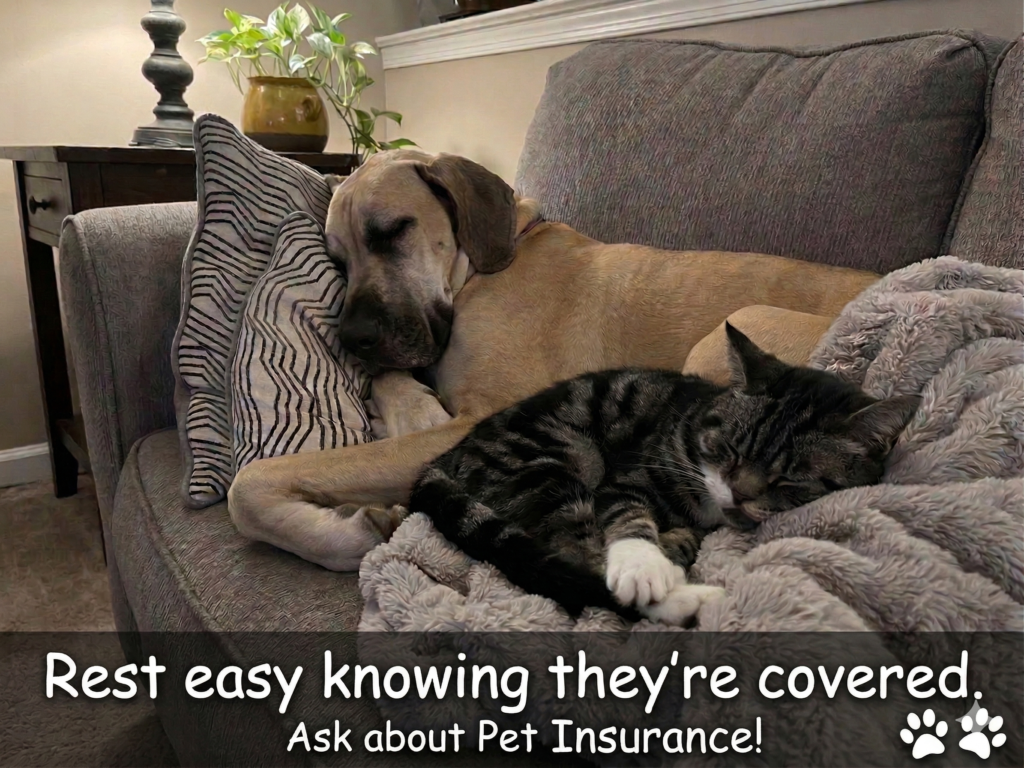
Marley and Scotty are family. Ensure they get the best care with pet insurance. Call 800-425-5130 for a free quote and peace of mind today!
Rest Easy: Affordable Pet Insurance for Your Family
Marley and Scotty are more than just pets; they are members of the family. For Instance, whether it’s a Great Dane sprawling across the sofa or a tabby cat nestled on the couch beside her, our animals bring a unique joy to our homes. However, that joy often comes with the responsibility of managing their health and wellness.
Why Pet Insurance Matters
Many pet owners assume they can handle vet bills as they come. Additionally, while routine checkups are predictable, emergencies rarely are. Whether it’s a sudden illness or an unexpected injury, the cost of veterinary care can escalate quickly. By securing a comprehensive policy, you ensure that financial constraints never stand in the way of your pet’s life-saving treatment.
Specifically, pet insurance can help cover:
Accidents and Injuries: From broken bones to swallowed objects.
Chronic Conditions: Ongoing care for issues like allergies or arthritis.
Diagnostic Tests: X-rays, MRIs, and bloodwork that can be costly.
Peace of Mind for Your Household
Furthermore, having insurance allows you to focus on what matters most: your pet’s recovery. According to the American Veterinary Medical Association (AVMA), having a plan in place is one of the best ways to be a proactive pet owner.
Don’t wait for an emergency to happen. Ensure Marley, Scotty, and the rest of your furry family get the best care possible.
Moving from Pennsylvania to Maryland? Learn exactly how to handle your auto insurance, home insurance, MVA inspections, and excise taxes to avoid penalties.
Moving across state lines is an exciting milestone, but transitioning between Pennsylvania and Maryland comes with specific regulatory hurdles that can catch drivers and homeowners off guard. At Homesale Insurance, we serve clients from Harrisburg and Lancaster all the way down to Westminster and the Baltimore suburbs. We know this corridor intimately.
If you’re asking, “What happens to my insurance when I move from PA to MD?”—here is your complete, step-by-step guide.
1. The 60-Day MVA Window (Do Not Miss This)
When you establish residency in Maryland, you have exactly 60 days to register your vehicle with the Maryland Motor Vehicle Administration (MVA). If you fail to do this, you risk facing a penalty tax of 6% of your vehicle’s current value.
Before you go to the MVA, you must have a valid Maryland auto insurance policy in place. Maryland requires your insurance provider to electronically verify your coverage with the state.
2. The Maryland Safety Inspection
Unlike Pennsylvania’s annual safety and emissions inspections, Maryland requires a one-time, highly rigorous safety inspection when you bring an out-of-state vehicle into the state.
Action Step: You must pass this inspection at a licensed Maryland inspection station before you can get your hard plates. Your Homesale Insurance agent can help you time your policy start date perfectly to align with your inspection schedule.
3. Auto Insurance Minimums: PA vs. MD
When you switch your policy, you will notice differences in coverage minimums.
Pennsylvania: Requires $15,000 for injury/death of one person, $30,000 for injury/death of more than one person, and $5,000 for property damage. PA also utilizes a “Choice No-Fault” system (Limited vs. Full Tort).
Maryland: Requires higher minimums: $30,000 for injury/death of one person, $60,000 for injury/death of two or more people, and $15,000 for property damage. MD operates under a traditional “At-Fault” system.
Because of the shift from No-Fault to At-Fault, and the increased minimums, it is critical to have an independent agent shop your rates to ensure your premium doesn’t spike.
4. Homeowners Insurance: Inland PA vs. Coastal MD
If you are moving from a central PA city like Carlisle or Camp Hill down toward the Chesapeake Bay or Ocean City, your home insurance risk profile changes completely.
Wind and Water: Properties on the water or very close to the Chesapeake Bay or Ocean City, Maryland are often subject to different windstorm deductibles and flood risks compared to central PA. Standard homeowners insurance does not cover flooding. If your new MD home is in a flood zone, we will need to secure a separate policy through the National Flood Insurance Program (NFIP) or a private carrier.
Let Us Handle the Transition
Dealing with the MVA and closing on a new house is enough work. You don’t need to spend hours on hold with 1-800 numbers trying to coordinate your policy switch. Because Homesale Insurance is licensed and deeply embedded in both PA and MD, we can seamlessly cancel your PA policies and bind your MD policies on the exact day you need them.
Contact Homesale Insurance today for a free state-to-state transition review.
Moving across the Mason-Dixon line involves more than just a new zip code. Pennsylvania’s insurance landscape operates differently than Maryland’s, particularly regarding your “Right to Sue” in auto accidents and unique regional property risks like sinkholes. Use this checklist to ensure your coverage crosses the border safely.
1. The Auto Insurance “Tort” Choice (The Biggest Change)
In Maryland, you have an unrestricted right to seek compensation after an accident. In Pennsylvania, you must choose a “Tort Option.”
Select Full Tort vs. Limited Tort:
Full Tort: Maintains your unrestricted right to sue for pain and suffering.
Limited Tort: Lowers your premium but restricts your legal rights unless the injury is “serious” as defined by law.
Update Your Medical Benefits (PIP): PA requires a minimum of $5,000 in Medical Benefits. This is a mandatory coverage.
PA Vehicle Inspection & Registration: You have 20 days after titling your vehicle in PA to get it inspected. Your insurance must be active and PA-specific before you can register the vehicle.
2. Homeowners Insurance: The “Ground” Factor
Maryland’s coastal and suburban risks differ from Pennsylvania’s limestone-heavy geography.
Add Sinkhole Coverage: If you are moving to Lancaster, York, or the Cumberland Valley, you are in a high-risk area for sinkholes. Standard homeowners policies exclude earth movement. Ask for a specific Sinkhole Endorsement.
Check for Mine Subsidence: Moving toward Western PA or specific parts of Schuylkill County? You may need Mine Subsidence Insurance (MSI).
Water Backup/Sump Pump Overflow: With PA’s older infrastructure and basement-heavy homes in Lancaster and Reading, ensure you have a water backup coverage.
Common Questions About Moving Insurance from MD to PA:
Do I need a new insurance agent when moving from MD to PA? Maybe. Your agent must be licensed in the state where the risk (your home or car) is located. Homesale Insurance is licensed in both PA and MD, making us the ideal “border-crossing” partner.
Is insurance cheaper in PA or MD? It varies by zip code. While MD often has higher liability costs in metro areas like Baltimore, PA’s “Tort” system and specific regional risks like sinkholes can impact your premium.
Contact one of our Homesale Insurance Advisors today. We are ready to help you with your move from Maryland to Pennsylvania. 800-425-5130. You can also click on the QR code below to get started.